investment intelligence
medium_large

Investment Data Management

Build a more reliable investment data management foundation.

With Clearwater’s centralized investment data management, leading firms accelerate reporting, reduce operational risk, and leverage AI for deeper portfolio insights and true investment intelligence.
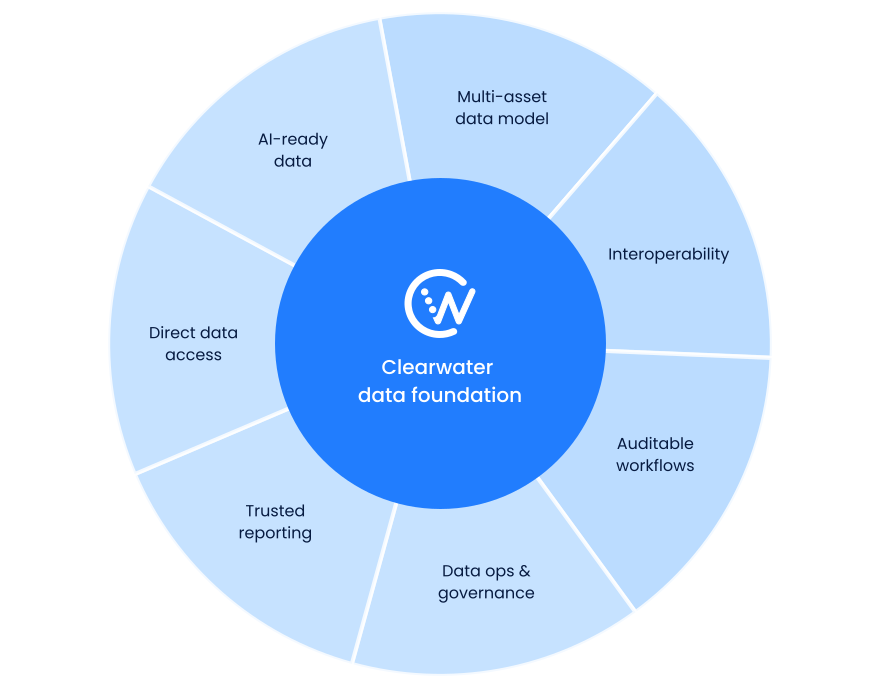
Why investment data management matters.

As investment operations become more complex, so does the need for centralized data management: automated, audit-ready, and built to flex with evolving demands. This is the foundation for everything that comes next.

Fragmented investment data leads to:

  • Conflicting numbers
  • Manual reconciliation
  • Delayed reporting
  • Unclear data ownership
  • Less informed decision-making
  • Poor audit readiness
  • Unreliable AI outputs
  • Weakened client trust

Clearwater helps firms manage the full investment data lifecycle.

Bring investment data together

Centralize investment data from custodians, administrators, vendors, internal systems, and spreadsheets, reducing the need for teams to manually stitch together fragmented sources.

Validate and reconcile data

Identify missing, stale, duplicated, or inconsistent data before it reaches reports, analytics, or downstream workflows.

Normalize data across teams and systems

Create more consistent formats, identifiers, classifications, and structures across portfolios, asset classes, currencies, entities, and systems.

Govern access and ownership

Support clearer controls around who owns the data, who can access it, how it changes, and how those changes are tracked.

Distribute trusted data

Make governed data available to reporting, accounting, risk, compliance, analytics, and investment teams, so more workflows can run from a consistent foundation.

Don’t just manage data. Act with intelligence.

Clearwater doesn’t just help you manage investment data. We also help you use trusted data as the foundation for deeper analysis, stronger oversight, and better decisions.

Investment data management answers

“Can we trust our data?”

  • Centralizes and governs data
  • Creates consistency across analytics
  • Improves data control across teams
  • Reduces time on reconciliation and reporting
  • Improves auditability

Investment intelligence answers

“What is our data telling us, and what should we do next?”

  • Enables AI workflows built on trusted data
  • Allows you to quickly move from analytics to insight
  • Helps teams identify risks, trends, and actions
  • Improves visibility and decision-making
  • Enables fast answers to compliance questions

Other platforms stop at managing data. Clearwater gives you true intelligence.

FAQs about investment data management.

Why do investment firms struggle with data management?

As investment firms grow, OMS/PMS platforms, accounting systems, custodians, reporting tools, and separate front-, middle-, and back-office workflows become disconnected. Each may use different formats, identifiers, timing, classifications, or definitions. As portfolios and asset classes become more complex, those differences create reconciliation work, reporting delays, and inconsistent views of the business. Clearwater helps reduce this fragmentation by connecting and normalizing investment data across complex operating environments.

How is investment data management different from a data warehouse?

A data warehouse stores data. Investment data management focuses on making investment data usable, trusted, and governed before it reaches reporting, analytics, or decision-making workflows. Clearwater helps address that investment-specific complexity by structuring, validating, and normalizing data so it can be used with greater confidence.

Why do we need an investment data management platform?

Without a central way to validate, normalize, govern, and distribute investment data, teams can end up reconciling the same issues repeatedly, working from inconsistent numbers, or delaying decisions while they confirm which data is accurate. A good investment data management platform will ingest data from multiple sources, validate and reconcile it, normalize it across asset classes and portfolios, apply governance controls, and make it available to the teams and systems that need it.

What types of investment data can Clearwater help manage?

Clearwater helps firms manage investment data across public and private markets, including the core data domains teams rely on for accounting, reporting, risk, compliance, analytics, and decision-making. This includes:

  • Security master and reference data
  • Holdings and positions
  • Transactions and cash activity
  • Pricing and market data
  • Investment accounting data
  • Private markets and alternatives data
How does good investment data management benefit AI outputs?

AI is only as useful as the data behind it. Good investment data management gives AI a strong foundation to work from, reducing the risk of incomplete, inconsistent, or hard-to-verify outputs.

Clearwater’s AI capabilities are built on its trusted investment data foundation, so our AI works with structured portfolio, accounting, risk, operational, and reporting data. This helps teams ask questions, surface insights, support workflows, and generate reports using data that is validated and governed.

How does investment data management connect to Investment Intelligence?

Investment data management creates the trusted foundation. Investment Intelligence turns that foundation into insight. Clearwater helps firms move from managing data to acting on it by connecting governed investment data to clearer portfolio visibility, stronger oversight, faster analysis, and better-informed decisions.

Still have questions?